
In this month’s article I take a look at team culture – and how to go about creating one you want.
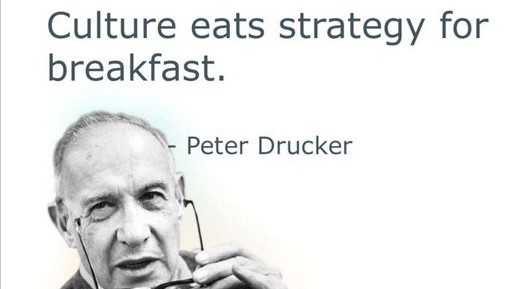
Every team develops its own culture.
Some are created by design but most are left to evolve organically – guided by the person with the biggest personality.
Maybe you’re lucky and have a fantastic team culture that just happened. If not, you might want to stop and think whether you need to lay some better cultural foundation stones.
Where would I even start?
Building great team culture is a recipe and everyone has their secret sauce.
But at its simplest, team culture is built on 3 foundation stones:
- Character – the ethics or values you and your team work to
- Behaviour – your habits
- Attitude – the way you approach these habits
Character – the Values you live by
Here’s the main problem with not having written values – and the main pitfall in writing them.

We think we are highly consistent.
There are perhaps 100 different values – all of them good at heart obviously – but many of them are potentially contradictory.
Some things are clearly and obviously a ‘no-go’ – stealing from a little old lady, say – but it’s the less obvious moral quandaries that cause problems for teams. Do you tolerate behaviour from your star performer that you would clip someone else for? Or from a client or supplier? Do you ask one thing from your team but then do something different on that ‘one’ day you’re stressed or anxious?
You won’t notice because we don’t see our own blind spots. You’re a good person and none of the values are bad as such. Just a bit contradictory.
And your team find you harder to predict – and copy.
Values – how to create a list that really fits
This is also the root of the main pitfall in creating your list: it’s great to be aspirational, but then you’ve got to walk the talk.
So how do you choose?
Here are 3 exercises to help you.
- Write down your red-lines. The things you simply will not tolerate. Your non-negotiable Values are the opposite of these.
- Think of someone you deeply admire – and preferably know – what would their values be?
- Ask yourself how you want to be remembered – as an employer. In your industry.
This will give you the raw ingredients of a great list of values.
Restrict yourself to 5 maximum – because if you try to stand for everything …
Pro Tip: The best format is a single word and then a sentence to explain why you chose it.
Great read: 7 Questions to Find Your Purpose by Richard Jacobs
For a more in depth read on Values: Business Values: Beyond Buzzwords – A Practical Guide for UK SME Owners – Tim Brown – ActionCOACH
Behaviour – your Rules of the Game
Values give you an over-arching framework but of course they are subject to interpretation.
A well thought out list of your Rules of the Game allows you get to be a bit more prescriptive. To mould and teach how you and your team ‘shows up’.
Remember, things that grind your gears might be water off my back – and vice versa.
That could be punctuality, a dress code, an approach to health & safety, good manners, communication, avoiding pointless meetings, taking holidays – or in the case of Netflix, not taking holidays.
I was lucky enough to spend a morning being coached by Sir Clive Woodward a few years ago. By this stage, he’d already coached England to winning the Rugby World Cup and had been Chef de Mission for Team GB at the Olympics.

The theme for the morning was how to proactively build a winning team culture.
One of his ideas was that the team should create a list of rules that they all agreed to buy into.
An example of this was the agreement to adopt ‘Lombardi Time’ – named after the legendary American Football coach of the 1960s.
The idea was that ‘on time’ for a meeting meant being sat down ready to go 5 mins before the scheduled start time.
Every new player introduced to that team was given a copy of the black book of Teamship Rules as SCW called it – and asked to sign off on it.
Pro Tip: This is best done as a team exercise – it helps ‘buy in’ – in the context of your long term ambitions.
Great Read: No Rules Rules: Netflix and the Culture of Reinvention by Reed Hastings
Attitude – the way you approach everything
You can have the world’s best Values and Rules of the Game, but they’re useless if your team’s attitude is ‘off’.
It’s easy to talk about a positive mental attitude but it’s much harder to define.
No one thinks they have an ugly baby, and no one thinks their attitude stinks.
Having a framework to allow people to self-regulate is a really useful step. And this framework is one of the best.
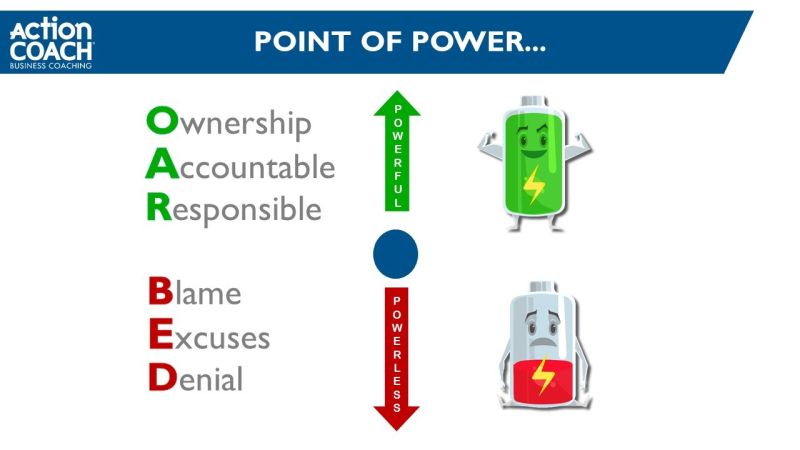
Imagine there’s a breakeven point in mental attitude – that’s the Point of Power.
Below that point you find the acronym BED.
- Blame – it’s always someone or something else’s fault
- Excuses – if you don’t want to do something any old excuse will do
- Denial – refusal to even acknowledge that a problem exists
Above the breakeven point is the acronym OAR.
- Ownership – proactive people who are happy to take responsibility
- Accountability – people who are happy to be held accountable to doing what they said
- Responsibility – people who are happy to be given responsibility
When you look at the graphic, and those descriptions, you’ll appreciate it’s like a mindset ladder.
One of your jobs is to take you and your team up that ladder.
In fact, you can forget pretty much everything else. If you can get you and your team consistently above the Point of Power, everything else is gravy.
Pro Tip: Best make sure you’re above the line before pointing the finger of blame at other people!
Great Read: 7 Habits of Highly Effective people by Stephen R Covey
It’s worth considering this
All of these ideas are useless if you view creating them as the finishing line.
We’ve all come across businesses with fine, aspirational values on their website that bear no connection to their day-to-day actions.
Over the years I’ve spoken to many business owners who have told me they have a set of values in place.
Fantastic, what are they?
Cue awkward pause while they get onto their own website to help them remember.
These are only valuable if they are the starting point. For your decisions, actions and habits.
Having a growing team almost guarantees you a steady list of ‘moral dilemmas’. These tools give you a frame of reference to make better – more consistent – decisions. Which will make sense to those around you.
Best regards,
Tim
Want to discuss this for your business?
 Book a call: Contact Us – Tim Brown – ActionCOACH – Let’s Have A Chat
Or contact me direct on 07825 589333.